
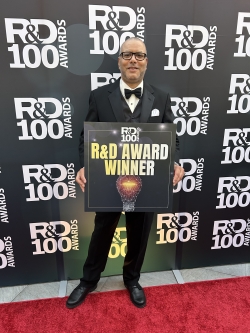
Edit update: Israel Owens at the R&D 100 awards ceremony
Israel Owens, GR '04, is set to accept one of the highest honors of invention later this year at the R&D 100 ceremony. Dubbed the 'Oscars of invention', the R&D World magazine awards the 100 most technologically significant products and advancements each year from around the globe. Owens will be accepting this award for his Electro-Optical Sensor submission.
Owens is a principal member of technical staff at Sandia National Laboratories in New Mexico. He also serves as the PI of the Sandia National Labs team that built the Electro-Optical Sensor. Their EOS is an optical device that completely transforms how we can measure high-voltage equipment. Using a dime-sized crystal and a shoe-box sized laser, the EOS can measure up to 20 million volts with no physical contact to the electrical source.
Given its compact size and no-contact measurement method, the EOS offers incredible safety benefits for workers in high-energy environments. The EOS was designed and tested to work with accelerators at Sandia Labs. Sandia's accelerators simulate X-ray and gamma ray radiation, allowing scientists to research potential effects of nuclear weapons. The EOS would also keep workers safe in other high-voltage situations, like the power utility industry.
Unlike its competitors, the EOS also maintains a linear relationship between the measured signal and the actual voltage. Its crystal size and laser configuration allow for remote placement, making minimal disruptions to the electric field that the EOS is measuring. Simplifying and streamlining the measurement process this way has created some of the most reliable and accurate voltage readings in high-energy environments. For Owens and his colleagues working with accelerators, accurate voltage readings are absolutely critical.
Owens first focused on electro-optical systems as a physics graduate student here at Dartmouth. He began his studies in 1998 under the late Professor John Walsh and completed his work under Professor Hayden Brownell by 2004. Reflecting on the sudden death of his advisor John Walsh, Owens recalls that the decision to continue his work 'required a lot of faith, persistence and support from Professor Hayden Brownell and the whole Physics Department'. Owens ultimately specialized in novel tabletop free-electron laser sources with far-infrared tunability.
After graduating from Dartmouth, Owens became a postdoctoral fellow at Los Alamos National Laboratory. There, he built an entangled photon quantum key distribution system. He was then promoted to a Staff Scientist position and developed outdoor remote sensing techniques. After 9 years at Los Alamos, Owens moved to his current position at Sandia National Labs.
The preliminary development of an EOS started when Owens joined Sandia National Labs in 2017. Owens recalls one big challenge was that 'researchers were unsure if a dielectric sensor would survive in a high energy environment with electrons and gamma rays'. Indeed their initial designs did not work – they exposed too much sensitive material to the damaging high energy environments. With clever and careful redesign, Owens and his team were able to minimize the device areas affected by hostile environments. Owens then published his team's successful use of the EOS in a high-energy accelerator in 2021.
Sandia National Labs has earned 169 awards from the R&D 100 since 1965. Owens is proud to be part of a group that has a high innovative output, and enjoys his job there. When asked about Sandia Labs, Owens describes it as 'a place where we deliver essential science and technology to resolve the nation's most challenging security issues'.
While producing award-winning technology is certainly a highlight, most of his day-to-day involves overseeing technical projects. This includes technical meetings, benchtop laboratory testing, and field deployments onsite and around the world. Owens adds 'on any given day, I could be called on to address an emerging technical issue related to national security'.
Owens plans to continue developing the EOS for commercial opportunities with power utilities and high energy research facilities. Owens will accept his award at the R&D 100 ceremony in Scottsdale Arizona on November 20th. For more information about the Electro-Optical Sensor, you can watch Sandia Lab's short video, or read their product news release. Visit R&D World magazine's full 2025 award list here.